The Brink Of Oblivion
Previously on The Reconstruction, we murdered the leader of Kir'Ssha's army, putting an end to the war between it and Do'Ssha. But none of that matters now, because the world ended, and Dehl snapped. We may not be able to find whoever's responsible, but we can at least go after the guy who's keeping the world from bouncing back.
We commandeer one of the few seaworthy ships left in this ruined world, and head out into the Drop (incidentally, the same place where we fought the Tatzylwurm earlier), where the Lord-God's tower is located. So after the world ends, we fight the villain in a tower? Is this what being subversive means, copying your endgame from one of the most well-known JRPGs of all time?

I guess we have to clear off any loose ends we can before wrapping things up, so here's Skint, who got his legs ripped off by the Lord-God's Si'Shra minions. Looks like the apocalypse got in the way of his plan to liberate the Shra, now that its most powerful members are under the command of the Lord-God. And as for his partner? She's dead, proving once and for all how useless she was.
Dehl is suprised to see him, not because of the state he's in, but because he thought that he was the Lord-God. Sure, he wanted to liberate the Shra, but there was no sign of him wanting anything to do with the Si'Shra. I can see why Dehl, as well as some players, would think he's aligned with them, but still, did he really expect the one other Shra that the guild met more than once to have the means or desire to be the world's supreme overlord?
Like Rehm, Skint has Wolverine-level healing factor, and even though he might end up healing from his injury, what's the point if all it means is that he will suffer in a ruined world?
You know how I mentioned that this is basically ripping off Final Fantasy VI? That game did things better, as at least there you had actually explore the ruined world in search of your missing party members, so you actually had a sense that the world was barely hanging on. Here, you just get a cutscene before shipping off to the villain's lair, where there's someone there to blab about how the world is ruined.
Now where was I? Right, Skint asks Dehl to kill him by pulling the sword out of him. But before that, he groans about how he will die alone, so his spirit will wander in torment. Yes, the thing that was brought up in Kulkumatz's quest. For that, Dehl suggests that he be signed onto the guild's roster, even as merely a symbolic gesture. And as per usual, it even plays the fanfare.

Dehl...don't you remember? He was the one who asked you to help him, and you turned him down.
One last thing before we say goodbye to Skint: remember the plague that was mentioned all the way back at the start of chapter 1, as well as the plague Dehl's father was ranting about in the interlude before chapter 5? They are one and the same, Dehl's father engineered it (because somehow, the pacifist lizard man has a background in microbiology), Dehl and Moke brought it back with them from their island, then Skint caught it when he tried to tend to Moke, and when he got stabbled, it spread to everyone else. That's why he's called the Scourgelord.
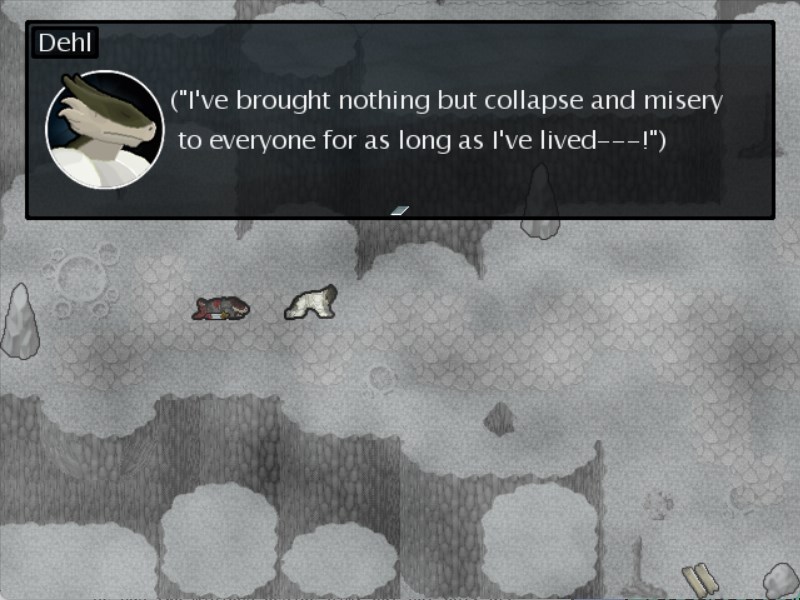
Again, there were good things that you and your guild have done (okay, maybe just one). It's not your fault that they were suddenly torn out from under you. If anything, it's that old hag's fault for not being clear on anything that this ascension business entailed!
On the plus side, now that we know that Skint isn't the Lord-God, there's only one person we know that could have possibly gained command over the Si'Shra.
So before we move on, let's count up all the important characters that we've met that are most likely dead. There's Hiu, the biologist from Wadassia, Asarik, the captain of the Nal officers, all of the councillords of Fortifel, Sirush's wife, those guys who were working with Kidra, Falitza's brother, Yacatec and the rest of the Berylbrine Outpost crew, Brenetto, Mahk, and Syri. In other words, pretty much everyone we've helped, as well as everyone that our guild members were close to.

Dungeons have never been this game's strong point, and as far as the Lord-God's tower goes...at least it's an actual dungeon, rather than a cutscene followed by a boss like with the last two chapters. But all there really is to it is a mini-boss rush and a key hunting puzzle. Even the chapter 1 dungeon had more thought put into it than this.

There are only three types of enemies, that each specialize in a certain type of damage: Enforcers deal with body damage, Manipulators deal with mind damage, and Dominators deal with soul damage.
Oh, and Yacatec's not dead after all, he's just been enslaved by the Si'Shra. A fate perfectly suited for someone like him.
And here's your very last chance to guess at the Lord-God's identity. Who do we know that would have made a show of force towards the Si'Shra, causing them to view them as an authority?
The Final Battle (click to view)
It's Havan. Think about it, after we defeated the Si'Shra warden, he was the one who convinced the Si'Shra to stand down, thus, going by Skint's statement that they gravitate towards who they perceive as the strongest, he's become their leader.
In the ten years since the guild ascended, he's had time to think about things. Things such as the inherent unfairness of how our guild managed to be chosen by the gods, yet he was not.
You know, that's a very good question. What does make us different from you? Both of us were contacted by Fell, and there are several cases where we've worked together, yet our guild is the one that fulfilled her arbitrary requirements. But then again, maybe the criteria aren't hers to determine, but those of the gods that she and the other Watchers worked for. I guess this is the reason that she kept talking about scope.
And don't think the game forgot about the artifact that he was hyping up back in chapter 2. Because now we know what it's for, giving whoever's nearby when it activates immortality. So this is how he got it in his head that he's the god of the new world.
Speaking of the gods, the Watchers didn't bother pulling up the ladder in the Violet Sands, so he was able to climb up, murder them, then carry Donz back to torture him. After all this time, and given their roles, you would think them to be untouchable, but now they're all dead due to a simple oversight.
Of course, those two guys that he was with come to support him. At least he has more reason to bring them along than Zaka did to bring four guys to face the party with him.
Like in The Demon Rush, the cutscene before the final battle gives us one of the game's best lines:
It sounds like the game is afoot, then! The winner shall inherit the ashes of the world!
And then the final battle begins. Or maybe not, even though the guild is about to face an insane former guild leader for the fate of what's left of the world, Tezkhra's more interested in the artifact, to the point where he's willing to blow up the tower that they're on to get at it. Then something about him reacts with Havan, causing his armor to turn pitch-black and him to start spouting stuff about chaos and discord.
It's funny, isn't it? The game's promotion makes a big deal of how subversive it is, yet if you unlock the secret character, he'll make the normal final boss start spouting typical JRPG endboss stuff.
Dehl asks Tezkhra to stand down so the rest of the guild can have their battle. He can stay in the active party, though. He's a suprisingly decent tank.
For being the final boss, he's not very hard. He has two minions beside him, but they are barely any tougher than Zaka's were, despite being the real threat of this battle. Adi has an attack that does extra damage to targets that are the same element as her, while her own element changes every turn, and Cort has a physical AoE attack. Our first AoE attack coming from a boss since chapter 3, and it's not even used by the actual boss.
They're only hard if they get off their dangerous moves at the start, before you have the chance to build up Chain and Rush. But once you do, they abruptly cease to be a threat.
Now, allow me to list all of Havan's moves. One, he can attack one target, and which health bar it damages is random. That's it. He does have one trick up his sleeve, though. Unlike every other enemy in the game, he doesnt go down when you take out just one of his health bars; You need to drain all three of them to win. However, you'd have to be actively trying in order for your party to not be capable of dealing all three types of damage.
Ending and Final Thoughts (click to view)
Havan is defeated, but he's not dead just yet. He retreats to a secret passageway leading to the tower's entrance. So what does he plan to do once he's escaped? That artifact of him seemed to have a limited range of effectiveness, and without the immortality that it grants, he seems to just be some guy with impractical-looking armor and stolen weaponry.
Not that we have to think about it for too long, though. The survivors from what's left of Wadassia managed to make their way to the Drop on rickety, leaky rowboats. Boy, I sure do love plot conveniences! The horde of starving, desperate survivors block off his escape, allowing Dehl to cut him down. This is what happens when you desperately try to seek validation from weird old women.
So it looks like Havan was wrong about there being nothing left to save, as with his death, and the Si'Shra no longer a threat, we can finally start with reconstructing the world. Zargos and Santes settle down and start a family, Nal goes libertarian, the people of Fortifel are thinking about using Metzino's technology to revive their city, because even in death, he will not stop receiving undue praise, Yacatec is trying to break in to the Shra capital for no doubt wholesome reasons, Moke is still on the Greater Shra's radar, and best of all, Dehl declares the end of slavery. Given the game's title and its emphasis on how Shra were being enslaved, I was all set to view this game as an allegory for the struggles of black Americans, but I abandoned that some time before we find out that they're all conceived and born in a rape dungeon.
But wait, what about the optional party members? Sirush has moved on from his dead wife, Kidra's aiding with the rebuilding effort in Nal, and Kulkumatz, being among friends, can die in peace. Rehm, as it turns out, isn't a Sikohlon at all, he just put on the white robe because he thought that they had a good thing going, even though the pacifism might have clashed with the lizard Errol Flynn thing he had going on decades ago. As for Falitza, now that everyone she's ever been close to prior to joining the guild is dead, she can now quit pretending to be insane and catatonic. No, this wasn't hinted at at all; despite her competence in battle, everything about her pointed to her being genuinely broken, and if the plan was to get away from her family, then surely, there must have been a better way than to get yourself sent to an open-air asylum, and there would be little point in keeping up the act once there!
But what about Tezkhra, the god and creator of the Shra? Why did he seem more interested in Havan's artifact than anything else?
It was screamingly obvious since we met him that Tez had his own agenda that didn't fully align with the rest of the guild's. And it seemed to involve gathering the other artifacts, like the one mentioned just now.
He goes up to the Watchers' domain...where he finds their emergency "nuke planet" button, and prepares to press it so that the other gods will come and pick him up.
This is already weird enough, but then he undergoes a sudden change of heart, and decides to contact his fellow "gods" himself, one of whom he adresses as Doctor Ramsend. So this is the game's final twist, this whole world that the game takes place on is the subject of a science experiment meant to analyse something called "latent energy". For whatever reason, this entails regularly seeding the world with life, then purging it completely after it reaches a certain level of technological development, and that was the purpose of the Watchers. Moral of the story, nothing you ever do matters, because at any point God could decide to nuke the whole planet.
I don't think I need to tell you that this ties into I Miss The Sunrise, this game's sci-fi prequel, as well as the unreleased How Far. I've never seen a game that ends on both a sequel hook and a prequel hook at the same time.
So that was The Reconstruction.
It feels like the one reason that it was showcased on RPG Maker's website was because of its unique combat system. I did mention when doing the prologue that it can be confusing for players used to more traditional RPG combat, and that I myself found it overcomplicated when I first played it in 2018.
Let's go back to the game's blurb, shall we?
Would you stake your life on a world that cannot be saved? Follow Dehl Sikohlon and his rag-tag guild, who strive to rid the world of turmoil!
So it looks like it was both a spoiler and misleading at the same time! The only people who actually say the world can't be saved are Skint and Havan, and both of them get proven wrong, although neither of them live to see it! And even then, both of them say so only in the last hour of the game. Speaking of turmoil, back in the end of chapter 2, we're told that the world is on the brink of an overpopulation crisis, even though nothing we've seen in the game so far or since even suggests it, and the eventual apocalypse makes the whole thing moot anyways.
The gameplay is solid, even though it can be janky and sluggish, the chain mechanic tends to limit your options, changing your party lineup is annoying, and a number of mechanics are tragically underused. Remember back in chapter 1, where we had to take into account our members' stats in order to determine who would explore the depths of the Broodmistress' lair? Remember when it had elements of an adventure game? Although some aspects of this do persist into the endgame, the final dungeon is a simple mini-boss rush and key hunting puzzle that makes little uses of the mechanics we were shown.
Building off of this, the characters' skillsets are a bit weird, with nearly every character having a skill that's either completely useless or situational at best. For example, Dehl has a skill that absorbs the disable status from a party member, and Sirush has a skill that is supposed to do more damage the lower your Rush is, but in practice, only does 1 damage whenever I used it. It's rather minor, but it shows that the game wasn't tested as well as it should. But then again, when you're working with RPG Maker XP, there's only so much customization that you can do.
The plot is a bit less solid. I don't mind a game being a series of episodic story arcs with one common element tying them together. The one game that I was reminded of was Romancing SaGa 1, where you spend 30 hours doing a bunch of disconnected errands until the game decides you're ready to fight the final boss. While The Reconstruction is slightly better about keeping its various quests relevant to whatever the current plot line is, it has this weird habit of advancing it in rather contrived ways, that make the guild come across as either incompetent or callous, such as with the end of chapter 2 (especially since there's nothing stopping you from going back to Nal afterwards), Rehm's sidequest, the Shra Capital quest, or the Kir'Ssha segment in chapter 5. And this is before we get into how Rehm's plotline, which you're introduced to before the actual main plotline, turned out to be completely irrelevant, especially since you can skip his recruitment quest altogether.
Speaking of the main characters, most of them are pretty one-note. While this can sort of be excused for the optional party members, the mandatory party members, particularly the starting party members besides Dehl, fare little better. Santes' antics start to get grating not even an hour in (and to add insult to injury, she's perhaps the single most useful party member), Qualstio's only contribution to most scenes where he's in tend to be quips, and he abruptly switches sides on the subject of Shra liberation just to justify the party not siding with Skint, and many of the others, such as Fero, are pretty much non-entities. Okay, there's the fact that Fero's from Kir'Ssha, which the party is trying to bring down in chapter 5, but nothing really comes of it. But that can be at least partially explained by most of them being inspired by Space Lizard's tabletop gaming buddies, and although I've never actually played a tabletop RPG myself, I know of their players' tendency to try to derail whatever storyline is being set up for them.
I suppose it would be neglectful of me to not mention Tezkhra, the secret character. Aside from the rather indifferent way he treats the guild's mission, which does make sense given where he's from and how he ended up on the surface, his whole purpose seems to be being not only a walking prequel hook, but also to establish the theme of scope that it sometimes remembers that it had. I don't mind him initially wanting to finish the Watchers' duty and nuke the planet, nor do I mind him eventually deciding not to, but what I take issue with is how abrupt it is, given that right before the final battle, he was perfectly willing to blow up the tower that the party was on to reclaim the artifact.
So, in conclusion, there are definitely things to admire about this game, but there are a whole bunch of flaws that hold it back, and may be the reason that it's not talked about that much nowadays compared to other RPG Maker games. That doesn't mean that it's not worth looking at, though. Of course, I started this game after finishing Dragoon Entertainment's games, and those can make almost anything look good by comparison.